Dungeon Year Design Journal
Build anything you can imagine, one piece a day.
The Dungeon Year is a daily creative challenge, mental exercise, a game itself, and a moment of meditation. You can start your Dungeon Year on any day in any month, and take as long as you want to complete it. The idea was started by Sean Mccoy, the game designer behind the Mothership RPG: To build a megadungeon one room a day in 2023 consisting of 12 levels, with 28-31 rooms each, called #dungeon23. His initiative sparked the idea of this journal and the Dungeon Year: To create something, one piece at a time until you have completed 365 details: rooms, characters, cultures, maps, stars, gods, items, and more. And when you’re done, perhaps you’ll have a massive interstellar spaceship, a new world to explore, a community of people and their relationships, a city, and yes, maybe even a dungeon.
Create anything you want.
How To Use The Journal
Day Entries
The day entries are what makes up most of this journal. 365 entries in total. Each one has a place for you to write your notes, encounters, tables, or descriptions, and grid for drawing and sketching. At the top of each entry is a place for an ID, Date, and Connection. In the ID field, give your day’s entry a unique identifier or number that you can reference elsewhere in the journal if needed. This can be as simple as the page number, or the date. Connections are what this individual thing connects to. If it’s a room in a dungeon, it’s the adjoining room IDs. If it’s an NPC, perhaps the connection is the building they’re in, or who they have a relationship with.
Dot Grid Paper
The dot grid pages are a perfect spot to sketch out the larger concepts of what you’re trying to make, or as a place to put it all together. For instance, if you were making a city, once a week, you can take what you made in each daily entry and add it to the city map that is on the grid.
Day Tracker
Each day that you work in your design journal, tick off a day on the tracker. We have designed the tracker to be used either as a simple counter, or as a calendar. How you use it is up to you. When you fill the tracker up, your Dungeon Year is complete.
Tables & Generators
When you need a source of inspiration, turn to the tables, generators, prompts, and oracle provided on the following pages. Below are two small tables that help you answer questions. Most tables are ‘d66’ tables. To use them, roll two six sided die. One acts as the tens place, the other the ones place. For example, if you roll a 3 and a 6, look up the “36” position on the table. You can combine results from multiple tables! Whatever the outcome of rolling on a table, use what you like, and change or discard what you don’t. These resources are there to help you – not restrict you.
Product Information
Product Information
Shipping & Returns
Shipping & Returns



Dungeon Year Design Journal
Dungeon Year Design Journal
Build anything you can imagine, one piece a day.
The Dungeon Year is a daily creative challenge, mental exercise, a game itself, and a moment of meditation. You can start your Dungeon Year on any day in any month, and take as long as you want to complete it. The idea was started by Sean Mccoy, the game designer behind the Mothership RPG: To build a megadungeon one room a day in 2023 consisting of 12 levels, with 28-31 rooms each, called #dungeon23. His initiative sparked the idea of this journal and the Dungeon Year: To create something, one piece at a time until you have completed 365 details: rooms, characters, cultures, maps, stars, gods, items, and more. And when you’re done, perhaps you’ll have a massive interstellar spaceship, a new world to explore, a community of people and their relationships, a city, and yes, maybe even a dungeon.
Create anything you want.
How To Use The Journal
Day Entries
The day entries are what makes up most of this journal. 365 entries in total. Each one has a place for you to write your notes, encounters, tables, or descriptions, and grid for drawing and sketching. At the top of each entry is a place for an ID, Date, and Connection. In the ID field, give your day’s entry a unique identifier or number that you can reference elsewhere in the journal if needed. This can be as simple as the page number, or the date. Connections are what this individual thing connects to. If it’s a room in a dungeon, it’s the adjoining room IDs. If it’s an NPC, perhaps the connection is the building they’re in, or who they have a relationship with.
Dot Grid Paper
The dot grid pages are a perfect spot to sketch out the larger concepts of what you’re trying to make, or as a place to put it all together. For instance, if you were making a city, once a week, you can take what you made in each daily entry and add it to the city map that is on the grid.
Day Tracker
Each day that you work in your design journal, tick off a day on the tracker. We have designed the tracker to be used either as a simple counter, or as a calendar. How you use it is up to you. When you fill the tracker up, your Dungeon Year is complete.
Tables & Generators
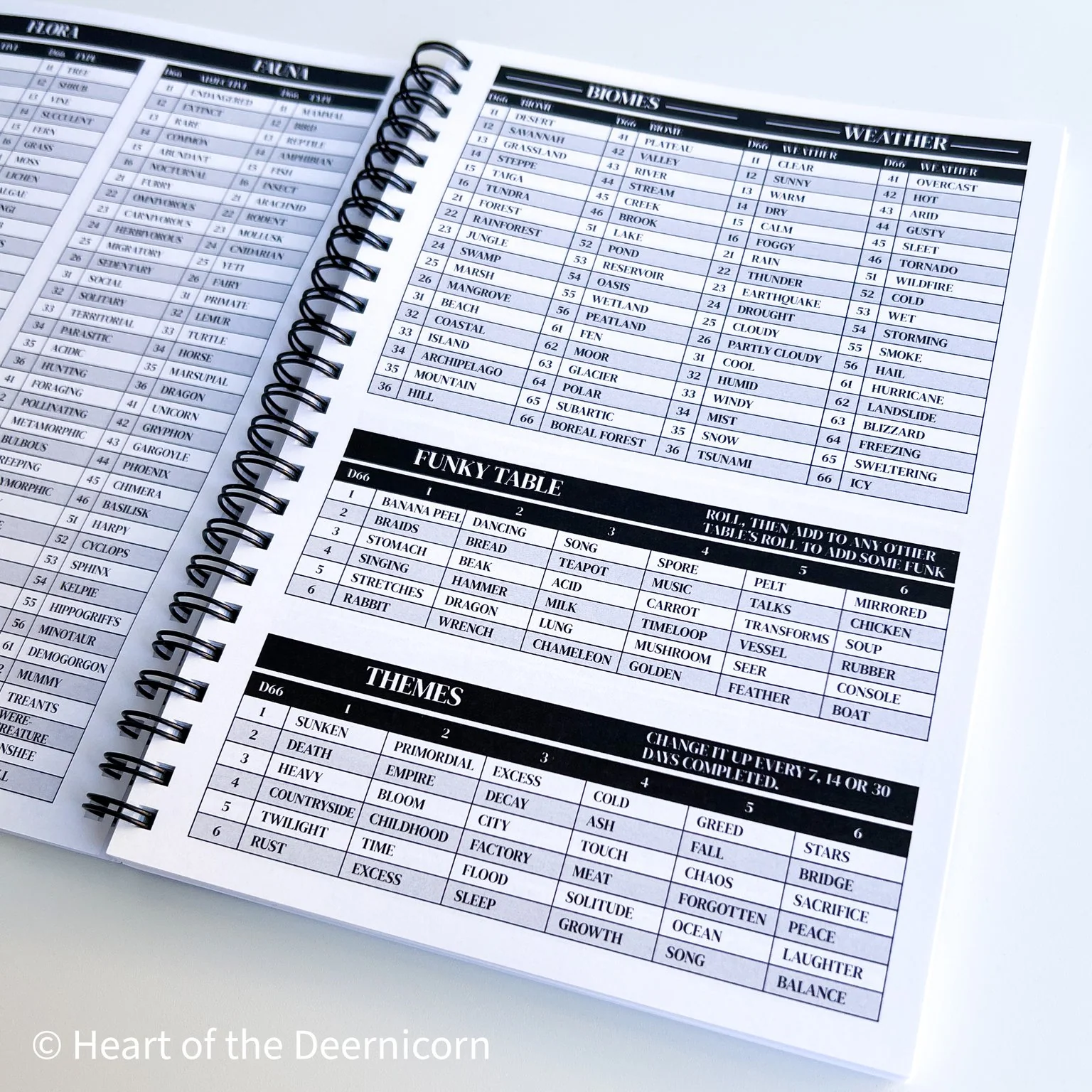
When you need a source of inspiration, turn to the tables, generators, prompts, and oracle provided on the following pages. Below are two small tables that help you answer questions. Most tables are ‘d66’ tables. To use them, roll two six sided die. One acts as the tens place, the other the ones place. For example, if you roll a 3 and a 6, look up the “36” position on the table. You can combine results from multiple tables! Whatever the outcome of rolling on a table, use what you like, and change or discard what you don’t. These resources are there to help you – not restrict you.
Original: $17.00
-65%$17.00
$5.95Product Information
Product Information
Shipping & Returns
Shipping & Returns
Description
Build anything you can imagine, one piece a day.
The Dungeon Year is a daily creative challenge, mental exercise, a game itself, and a moment of meditation. You can start your Dungeon Year on any day in any month, and take as long as you want to complete it. The idea was started by Sean Mccoy, the game designer behind the Mothership RPG: To build a megadungeon one room a day in 2023 consisting of 12 levels, with 28-31 rooms each, called #dungeon23. His initiative sparked the idea of this journal and the Dungeon Year: To create something, one piece at a time until you have completed 365 details: rooms, characters, cultures, maps, stars, gods, items, and more. And when you’re done, perhaps you’ll have a massive interstellar spaceship, a new world to explore, a community of people and their relationships, a city, and yes, maybe even a dungeon.
Create anything you want.
How To Use The Journal
Day Entries
The day entries are what makes up most of this journal. 365 entries in total. Each one has a place for you to write your notes, encounters, tables, or descriptions, and grid for drawing and sketching. At the top of each entry is a place for an ID, Date, and Connection. In the ID field, give your day’s entry a unique identifier or number that you can reference elsewhere in the journal if needed. This can be as simple as the page number, or the date. Connections are what this individual thing connects to. If it’s a room in a dungeon, it’s the adjoining room IDs. If it’s an NPC, perhaps the connection is the building they’re in, or who they have a relationship with.
Dot Grid Paper
The dot grid pages are a perfect spot to sketch out the larger concepts of what you’re trying to make, or as a place to put it all together. For instance, if you were making a city, once a week, you can take what you made in each daily entry and add it to the city map that is on the grid.
Day Tracker
Each day that you work in your design journal, tick off a day on the tracker. We have designed the tracker to be used either as a simple counter, or as a calendar. How you use it is up to you. When you fill the tracker up, your Dungeon Year is complete.
Tables & Generators
When you need a source of inspiration, turn to the tables, generators, prompts, and oracle provided on the following pages. Below are two small tables that help you answer questions. Most tables are ‘d66’ tables. To use them, roll two six sided die. One acts as the tens place, the other the ones place. For example, if you roll a 3 and a 6, look up the “36” position on the table. You can combine results from multiple tables! Whatever the outcome of rolling on a table, use what you like, and change or discard what you don’t. These resources are there to help you – not restrict you.